The BEST addition and subtraction worksheets? How can I make that claim?
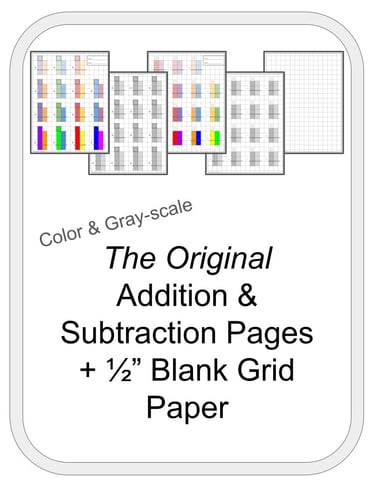
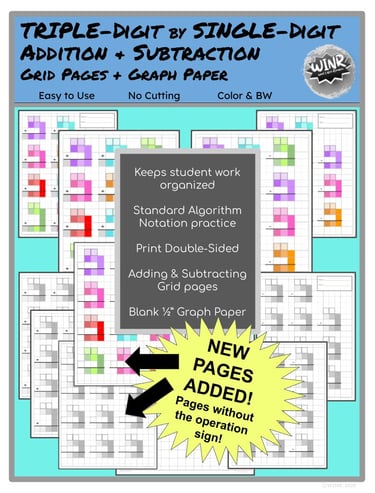
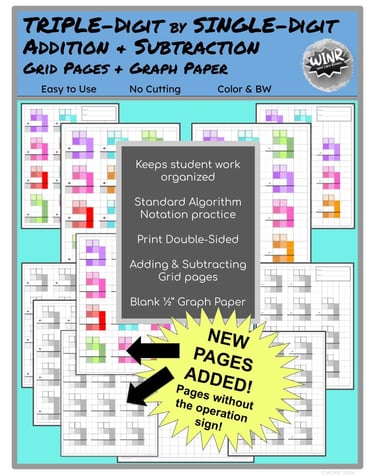
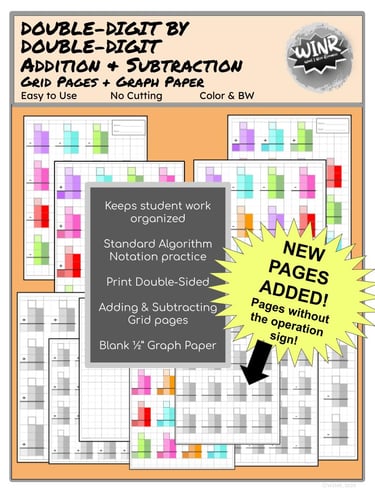
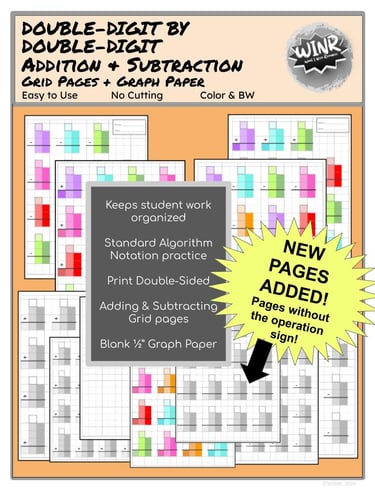
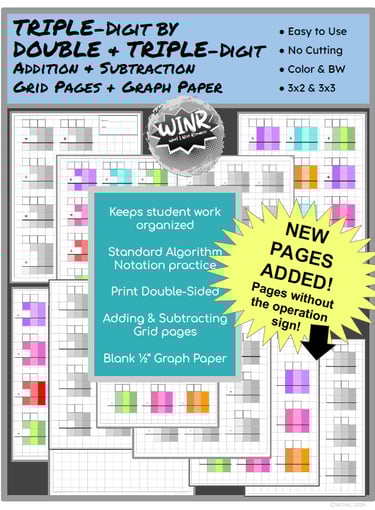
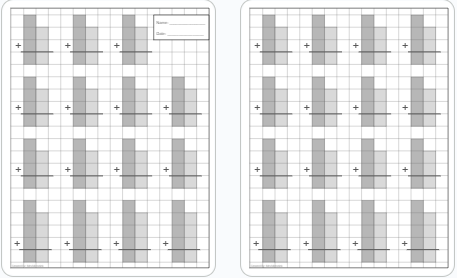
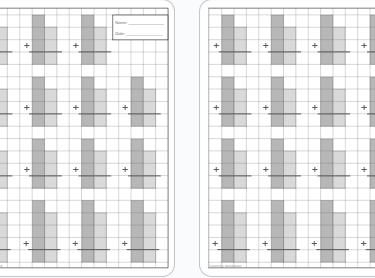
Well, I can, and I did. The best worksheets offer various levels of understanding within an organized structure. Just like teaching, I do, we do, you do, my addition and subtraction grid practice worksheets do just that. The worksheets are built over a grid that allows students to learn how to organize and place numbers according to place value. Pages start with the simplest computation, and build towards the most complex, just as some of the pages have the addition or subtraction symbol placed already, and others do not, which helps students think about the process and add it in.
I made these worksheets primarily for 1st and 2nd-grade students, but they can be used for any student who needs to boost their standard algorithm notation practice. When helping students to learn how to add and subtract, it is important to walk them through the process using various methods, such as on paper, with visual models, and with hands-on activities, before jumping into the standard algorithm. Connecting the new process to background knowledge is important, especially for the children who struggle to process numbers, symbols, and visual representations.
Suggested activities can include: working with counters or beans, base-10 blocks, bundles of straws or sticks, ten frames, tally marks, dot patterns, dice patterns, finger patterns, and subitizing dots. This is not an exhaustive list, but a way for you to think about how we add and subtract and the many ways it can be accomplished. It is also very important to showcase all numbers or quantities spoken about in terms of the written name, symbol, or digit, and visually. When discussing the number 10, a suggestion would be to write the word ten, show the digits 10, and show a ten-frame or a set of hands with fingers outstretched to show ten fingers. This gives students the whole picture. We may even show some computations such as 5+5=10 or 12-2=10. We may model the number ten with bundles of sticks or base-10 blocks. Also, the students may be asked to show various ways to make ten with their fingers. This is lovingly called "Moose Math" as students are asked to put their hands by their heads to mimic moose antlers while showing their finger patterns for numbers. Lastly, mental math skills will come in time as students master number systems and understand groups of ten and basic counting patterns, both up and down. In the beginning, they may be asked to remember how ten was made yesterday or to picture in their mind what ten looks like on a ten-frame or with tally marks.
Once students are ready to use their basic skills and move forward to notation, students start to use the standard algorithm and write numbers that symbolize the quantity they are used to seeing with counters, sticks, or fingers. They understand that a number equals the amount. For example, the number seven is the symbolic representation for 7 beans or a ten-frame that has its first row filled and two boxes filled on the bottom row. They understand that the number 7 is equal to five and two more or ten and three less. They start to realize 7 + 3 will equal 10, just as the reverse of 10-3 must be 7. These relationships build the ability to move between strategies and think of numbers as fluid relationships; each having their own ability to ebb and flow between the system of numbers and the strategies we use to obtain them.
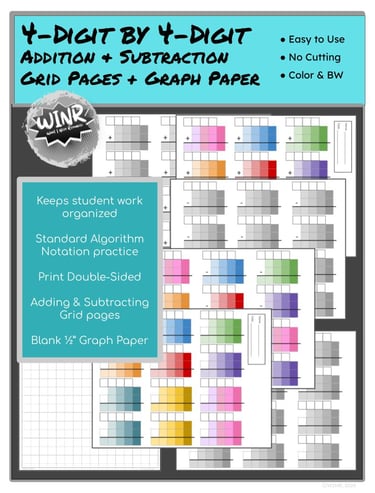
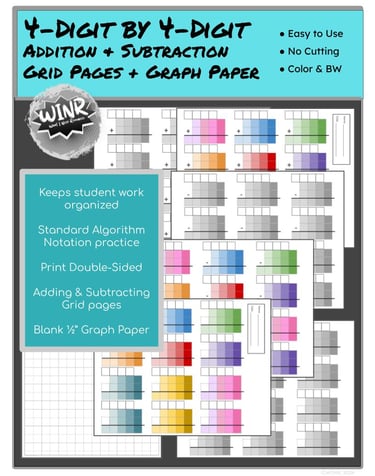
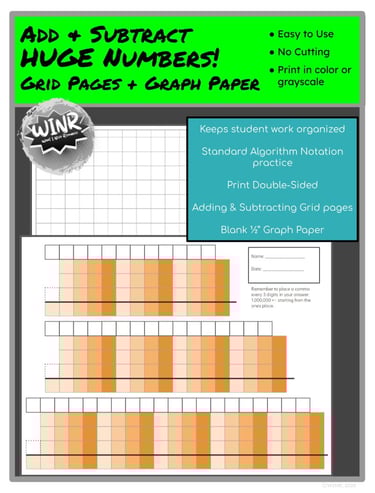
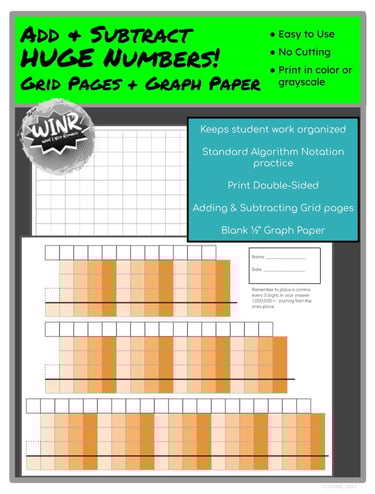
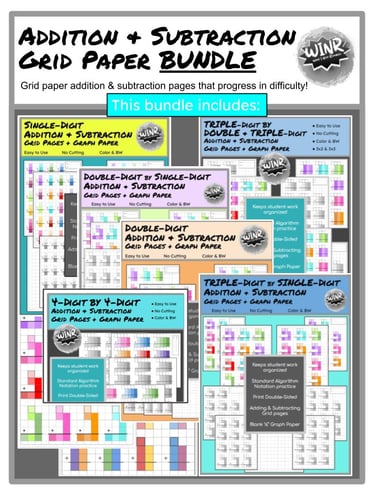
The addition and subtraction practice pages gently guide students into single-digit by single-digit addition and subtraction and progress them towards the mastery of four-digit by four-digit numbers, and lastly, to challenge themselves with HUGE numbers! I will link the worksheets here in progression from basic to challenge.
Progression of Addition and Subtraction Grid-Paper Practice Pages:
BUNDLE of all the addition and subtraction grid-paper practice pages
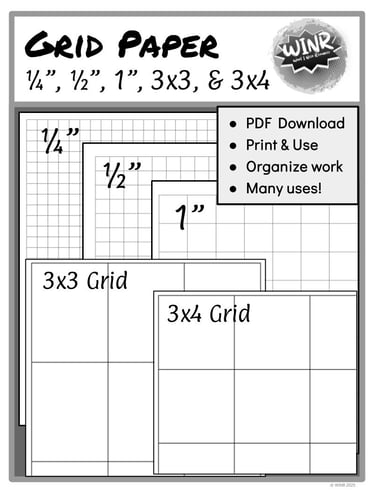
Free Grid Paper two-digit addition and subtraction pages, grayscale
Related Blog Posts:
Images: Mrs. M.



Printable educational tools for effective and efficient learning and teaching.
© WINR 2025. All rights reserved.
Have something great to say or a question to ask? Use this form!
Site Map